Designing Rose Mk2: a hull that anchors through the tide to reach the North Sea
A design study for Rose Mk2: a self-righting, solar-buffered hull meant to drift, unpowered, 373 km from Bonn down the Rhine and Waal, then thread the tidal Rotterdam approach to reach the open North Sea. Its predecessor, Rose Mk1, already did the Bonn–Cologne leg in a single day for a $57 bill of materials. Mk2 is still a paper-and-CAD design — bench and pool testing come before any hull gets wet — but the numbers behind it are real, and the most interesting one is where the design changed its mind.
The tide problem, and the fix that didn't work first
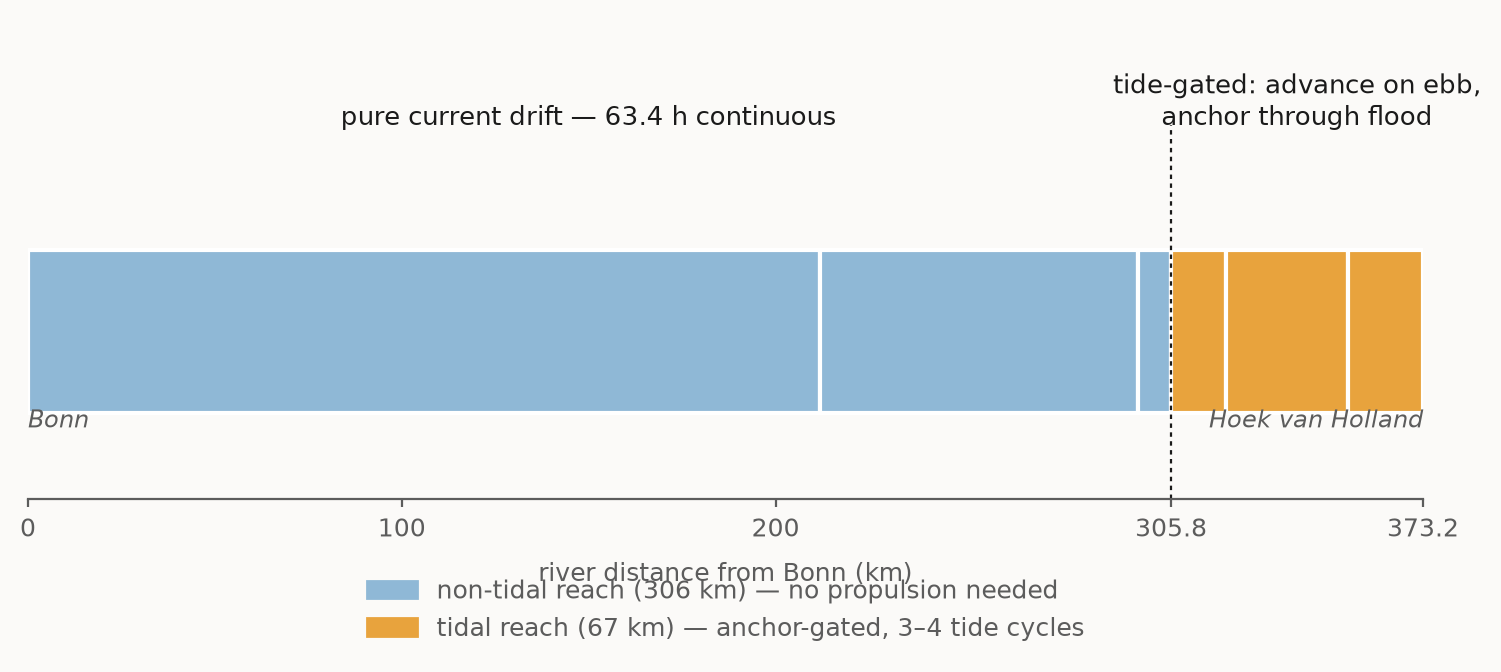
Most of the route is free: 306 km of the Rhine and Waal carry a current fast enough that the hull just needs to drift and nudge itself away from groynes. The last 67 km are different — inside the tidal Beneden Merwede, Noord and Nieuwe Maas, and Nieuwe Waterweg, the current reverses twice a day, and roughly half the time it runs backward. The first pass at this design tried to solve that with more of what Mk2 already had: twin thrusters, run at partial duty to shave the backward drift down to something tolerable. The numbers don't support it. Holding position against a full flood tide by thrust alone costs about 519 Wh over six hours — more than five times the entire usable battery buffer. A cheaper 20%-duty compromise was tried next, and a proper drift simulation found it doesn't actually hold: the hull still loses 16–26 km per flood phase, which is comparable to the length of the tidal sub-reaches it was supposed to be crossing.
The fix that does close the budget is older than the electronics by a few centuries: drop a small folding anchor on a rode when the tide turns against you, sit still for free, and cut the rode with a nichrome burn-wire the moment the tide turns back. Holding load on the anchor peaks around 29 N — trivial for a small anchor in decent ground — against a thruster system that would need to burn most of a day's power budget to do the same job electrically. The thrusters stay aboard at full size regardless, because lane-keeping, a speed boost on a good ebb, and a last-resort dodge in the shipping channel all still need them; what changes is that they're no longer asked to do the one job they were never big enough to do affordably.
A hull shape resolved by search
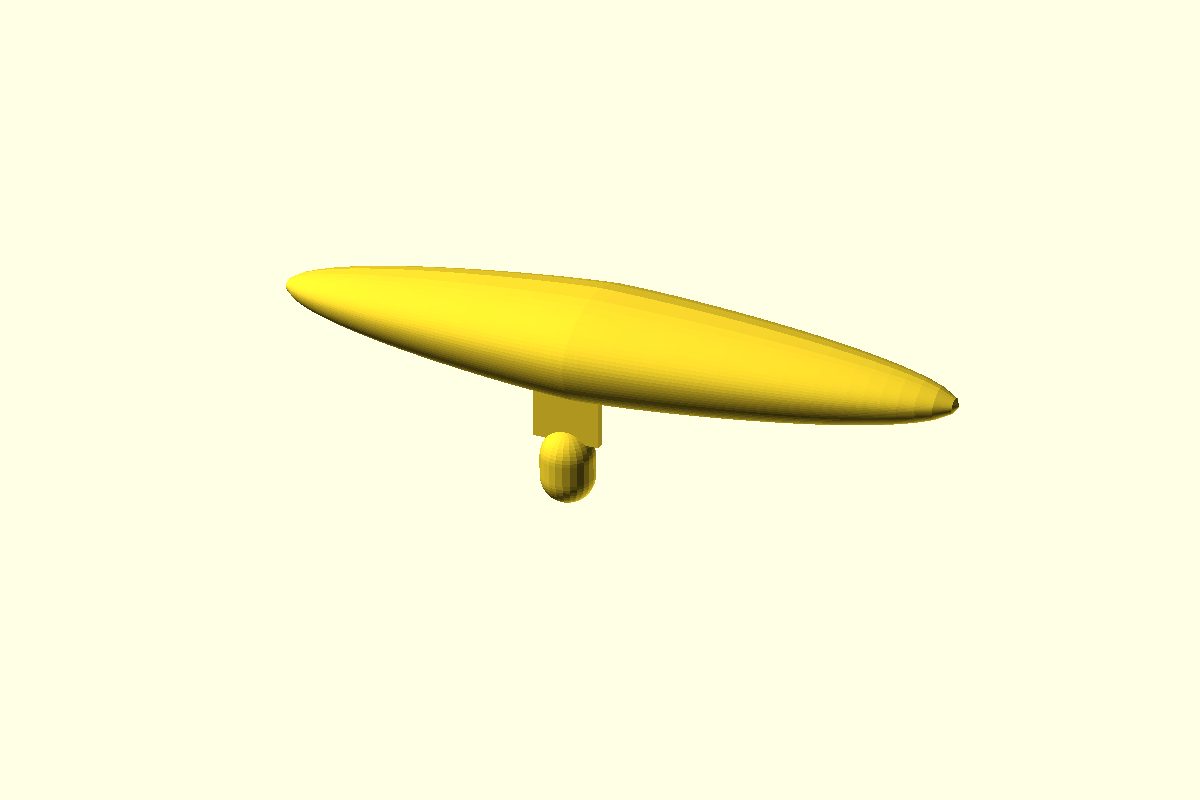
With total mass and ballast fixed by the rest of the design, the hull's actual shape — beam, how full or fine the ends are, how rounded the bottom is — was resolved by scoring 17,500 candidate combinations against drag, wetted area, a stability floor, and fit to real small-craft proportions, rather than drawn and hoped for. Against a naive untapered 30 cm-beam baseline, the winning shape is narrower (28 cm), deeper-drafted, and about 11% lower drag and wetted area — at the cost of 22% less stability margin than the baseline has. That trade only makes sense once you notice the baseline has stability to spare: even after giving some up, the optimized hull's GM of 13.1 cm on a 28 cm beam is still unusually stiff for a small craft, because self-righting here comes from the keel ballast, not the hull's own form. The mesh is lofted directly from the same parameters the search scored, and the resulting hand-hydrostatics-versus-CAD agreement — within 1% — is what a shape should give you when it isn't a separate drawing of the design, but the design itself.
Self-righting: what's proven, and what still needs a pool
The hull's cross-section is a chine-less "lens" — round-bellied at the waterline, tapering to a point at both the deck and the keel line — so it has no flat surface to rest on while upside down. Combined with a ballast bulb carrying 40% of the total mass at the keel tip, the design passes the standard offshore Capsize Screening Formula (1.16, against a threshold of 2) and CAD-derives a metacentric height of 13.2 cm from the hull's real waterplane geometry. What that math does not answer is whether the righting force stays positive at every angle from 0° to 180° — the actual definition of self-righting. A simplified model treating the ballast bulb as a pendulum confirms the righting term never goes negative, but it leaves out the hull's own buoyancy contribution through the 60–150° range, which is exactly the range that matters most and the one a spreadsheet can't settle. That's why the build plan treats a physical 180°-inversion pool test — consistent recovery in under 30 seconds across at least ten trials — as the actual go/no-go gate; the calculation only sets the expectation the test then has to clear.
The one risk the anchor can't fix
The tidal reach ends inside the Port of Rotterdam's shipping channel, carrying on the order of 325 vessels a day, and this hull has no radar, sonar, lidar, or any other ranging sensor — its one camera runs at a low duty cycle for logging, not detection, and wouldn't leave enough reaction time against a ship many times its size and speed even if it were faster. A rough Fermi estimate puts the vehicle co-present with 490–650 vessel transits during its own passage through the corridor, hugging the recommended small-craft line for what exposure reduction that buys. The honest conclusion the design reaches about its own biggest risk stops well short of solved: tide-gated timing, a passive radar reflector, and minimizing time in the corridor make an uncoordinated transit statistically less unsafe than doing nothing about it, not safe outright. Nothing at this budget closes that gap the rest of the way.